
A number of friends and familiy have been having babies and one of the most common things I hear is about lack of sleep.
Now it's not uncommon for new mums to be a bit irate at husbands who seem to complain about being tired when the mothers are doing all the work. However, I also hear about the opposite where the dad is up feeding the baby at night but mum is still being woken up and they're not having a good rest.
I am a fortunate person that I don't need much sleep, but that doesn't mean I don't need ANY sleep. But even with a new baby there was a way where we could work something out so that we both weren't tired and cranky all the time.
1. Only one person needs to suffer from lack of sleep
I find it rather selfish that women who are staying at home looking after the baby expect husbands to work AND get a lousy night's sleep. After all, someone has to go out and earn money so we can buy all the things we need - maternity pay only gets you so far (that is, if you are eligible for it).
I breastfed my babies for 6 months, and if I was going to do the feeding, I would take the baby to another room and go sleep there so hubby could get some sleep and function during the day. However, I need a bit of quiet time too! So on Friday and Saturday nights, I would have my turn to get good night sleeps and hubby would do look after the baby from 11pm till 6am (and do that 2-3am feed).

If you truly want to sleep, then your baby will have to get used to the bottle. Men don't have boobs to feed babies, so express some milk that dad can use or have a baby formula feed for that one time so you can get some sleep. What if the baby doesn't take to the bottle? Well, get ready for no sleep then - if you really want this to work, you have to train your baby! Guys tend to be overwhelmed by a baby crying who is clearly hungry and so the easiest thing is to give the bub back to mum for some boob time, but I think persistence is key, and you as the mother have to be on board with that and encouraging.
2. Don't let them sleep too much during the day
Newborns sleep A LOT. Like, 16-18 hours a day! But it's not all in one go, but in spurts after feeds. One of the biggest mistakes, I think, is to let your baby sleep a lot during the day, thinking that you are getting lots of time to yourself.
That's probably ok if you are going to sleep during the day too. However, that's rarely the case. Usually you spend the day doing chores or relaxing, rather than sleeping or napping. Then you are complaining because the baby is up all night sleeping only 1 hour spurts at a time - which is what you want them to be doing during the day an having that 4 hour sleep at night.
It is tempting to just let a sleeping baby lie, but I think it's better to wake up your baby if they are sleeping too long in the day. Personally, 1.5 hours is when I would start to wake them up and then try to get them to sleep at night because they would be cranky as by the end of the day with interrupted sleep.
3. Power napping
I highly recommend napping when baby is napping. Even if you're not sleeping, just closing your eyes and resting can be quite beneficial. Don't worry if you don't sleep, because that anxiety actually leads you to even LESS sleep. Just close your eyes and meditate or think calm thoughts.
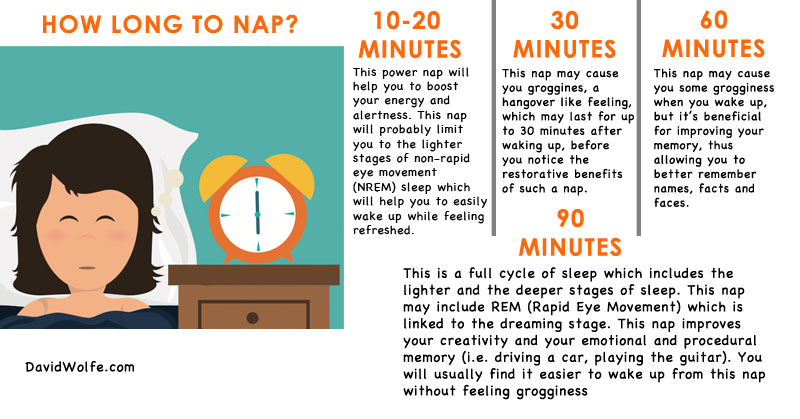
This little chart is useful, but everyone is different. Me personally, I have good sleeps in 2 hour blocks or even half hour ones but 1 hour ones seem to make me feel tired. It just takes a while to figure out what your sleep cycle is like.
4. Don't drink caffeine
It sounds pretty obvious, but it is easy to forget when you are used to being able to drink whatever you wanted!
I was an absolute idiot because I was drinking diet coke when breastfeeding and wondering why baby never slept much. Once I stopped doing that, baby slept so much better! I felt very silly. So if you're breastfeeding, think about that coffee you're having. You might need it, but baby won't be thanking you for it! I found chocolate an acceptable alternative and cups of tea. Still need to keep those fluids up to keep the milk going!
Good luck with your baby and your sleep! You will be tired, but hopefully you'll find your routine, and hopefully some of these little tips have helped.
Showing posts with label sleep. Show all posts
Thursday, 3 August 2017
Tuesday, 23 August 2011
Lying down with your kids to sleep - am I doing more harm than help?
We all get into that bad habit when the kids are babies where they settle when you carry them, and you get into the bad habit of carrying them to sleep. My daughter was like that until about 15 months of age when I left her with my parents for a bit and they kept carrying her to sleep. I was pregnant then and I did NOT want to carry her as she was getting heavy and so when I put her to bed I would lay down next to her and let her snuggle up to me and sleep. Of course it started off with wailing, crying, climbing all over me, tossing and turning, doing 360s in the bed... but it would work and after a while everyone saw that it worked and stopped carrying her.
But, 2 years down the track, we are still lying down to put her to sleep, and we do that for my son also. In fact neither of my children will lie down in their rooms to sleep on their own, they wail and cry and get hugely upset until they vomit if one of us doesn't lie down to sleep with them. We do leave them once they are asleep though!
I have often wondered if I am doing more harm than good. Everyone else has their kids sleeping in their own rooms, by themselves. I read lots of books about self settling and being firm, and though I have tried it, I am not successful and end up with tears, stress and husband/wife fights.
All the great parenting books will tell you that encouraging children to sleep in their own rooms allows parents privacy (and sanity). And I don't disagree! But what are the effects on children? Some studies say that there is an increase in cortisol when children sleep on their own (stress hormones). An article by Jennifer Coburn outlined some interesting research points.
It is likely because of the Western valuing independence. Children sleeping on their own, feeding themselves, is important in modern and Western values. Also it is a relatively new thing, in the last 200 years, that sleeping separately for infants has emerged. New psychologists say that parents need their time to themselves for the sake of their marriage, and that the children will develop abnormal sleeping habits if they sleep with their parents.
But, 2 years down the track, we are still lying down to put her to sleep, and we do that for my son also. In fact neither of my children will lie down in their rooms to sleep on their own, they wail and cry and get hugely upset until they vomit if one of us doesn't lie down to sleep with them. We do leave them once they are asleep though!
I have often wondered if I am doing more harm than good. Everyone else has their kids sleeping in their own rooms, by themselves. I read lots of books about self settling and being firm, and though I have tried it, I am not successful and end up with tears, stress and husband/wife fights.
All the great parenting books will tell you that encouraging children to sleep in their own rooms allows parents privacy (and sanity). And I don't disagree! But what are the effects on children? Some studies say that there is an increase in cortisol when children sleep on their own (stress hormones). An article by Jennifer Coburn outlined some interesting research points.
- Babies who sleep alone are more susceptible to stress disorders (Michael Commons, Harvard psychiatrist). When babies are left alone to cry by themselves, levels of cortisol (a stress hormone) rise, and constant stimulation by cortisol in infancy causes physical changes in the brain, making them more prone to the effects of stress, illness (including mental illness), and making it harder to recover from that illness.
- McKenna showed that babies who co-sleep spend time in Phase III sleep (which is where the risk of apnoeas is increased), and they learn healthy breathing patterns from bunkmates (gee you hope that mum doesn't snore or have sleep apnoea!)
It is likely because of the Western valuing independence. Children sleeping on their own, feeding themselves, is important in modern and Western values. Also it is a relatively new thing, in the last 200 years, that sleeping separately for infants has emerged. New psychologists say that parents need their time to themselves for the sake of their marriage, and that the children will develop abnormal sleeping habits if they sleep with their parents.
All this is very interesting, but it doesn't answer my question: Does sleeping with my kids to put them to sleep cause them to develop a bad habit or behaviour problem? Does it cause more damage than good? Because I am putting them to sleep so they know I'm there, but when they wake up they are alone. However, the kids are free to join our bed or ask us to come to their bed if they wake up at night. This is detrimental to my husband's sleep, but I don't find it too bad. Julian can now open his door and when he wakes up too early, I go and lie down with him until he is asleep. The same with Erika, she often comes to the room asking for me to sleep with her and I do. Is this detrimental to their health? It doesn't feel like it, but I can imagine for some families or parents who need more sleep than I do, that it can be detrimental for your sanity, rest, and wellbeing as well as the wellbeing of your marriage.
So I think I am tempted to say that lying down with my kids is NOT bad for them. It is bad for the parent who is busy or for those who have fragile marriages. I know that the one thing that I don't like about lying down with the kids is the amount of time it takes up. In this day and age where we value our own time, using your time like that can be annoying.
I will keep researching, and perhaps I might receive comments as well about people who know of some reasearch that either proves or disproves my ideas.
Tuesday, 1 March 2011
Insomina and sleep training/hygiene
I find the term sleep hygiene odd. Basically it refers to good sleeping habits (ie keeping the sleep timetable clean from distractions and corruptions) rather than sleeping after a shower and fresh undies.
A friend of mine is having difficulty sleeping, and it's something that I seem to see a lot of in hospital, patients saying they can't sleep unless they have their sleeping tablets etc.
So, before the start taking sleeping tablets (which are not a cure, and in the long term can be detrimental to sleep), here are some sleep tips.
(Interestingly, a lot of these translate to small children as well - I see the same tips for when trying to get good sleeping routines for babies and toddlers)
At night:
Stimulus control - the main goal is regain the idea that the bed is for sleeping. It involves the following:
A friend of mine is having difficulty sleeping, and it's something that I seem to see a lot of in hospital, patients saying they can't sleep unless they have their sleeping tablets etc.
So, before the start taking sleeping tablets (which are not a cure, and in the long term can be detrimental to sleep), here are some sleep tips.
(Interestingly, a lot of these translate to small children as well - I see the same tips for when trying to get good sleeping routines for babies and toddlers)
At night:
- use the bed and bedroom for sleep and sex only
- establish a regular bedtime routine and a regular sleep-wake cycle
- create a sleep-promotig environment that is dark, cool and comfortable
- avoid disturbing sounds - consider having a bedside fan or white noise machine to block out disturbing sounds
- Do something relaxing in the 30 minutes before bedtime, like reading or meditation
- Take a warm shower or bath 1.5-2 hours before bedtime, as taking a shower shortly before bed increases alertness.
- Avoid alcohol and caffeine especially late in the day. Consider no caffeine.
- Exercise but not within 3 hours of bedtime
- Avoid later afternoon and evening naps
- stimulus control
- cognitive behavioural therapy
- progressive muscle relaxation
- paradoxical intervention
- sleep restriction
- imagery tasks
- biofeedback
Stimulus control - the main goal is regain the idea that the bed is for sleeping. It involves the following:
- go to bed only when ready to sleep
- if unable to sleep within 15-20 mins get up and go into another room
- maintain a regular wake up time no matter how few hours you actually sleep
- avoid naps
- focus on one specific muscle group at a time. Most people start with the foot. Inhale and tense foot muscles for about 8 seconds. Relax the foot and let it become loose and limp, stay relaxed for 15 seconds then repeat on other foot
- move up to the next muscle group and repeat, doing one side of the body at a time. Work from foot and leg up to abdomen and chest then hands and arms then to neck, shoulders and face.
Subscribe to:
Posts (Atom)
