Showing posts with label Compost. Show all posts

Wednesday, 3 February 2016

Eww! Are those maggots in my compost bin?

I have been trying very hard to get my compost bin to work. I've been worried about the carbon to nitrogen ration, about what I put in there, and whether it was wet enough.

I started with some dry leaves and sticks in the bin, then I dumped a whole heap of shredded paper and cardboard into the bin and then started to layer scraps and paper. Once we got the chickens, I started to put their litter in there as well, and also the rat litter.

One problem was fruit. Whenever I put fruit leftovers into the bin the fruit fly clouds that would come out of the bin was a worry! I didn't want to get any fruit flies into my mouth or my nose! I thought that if I kept covering the fruit with more carbon (paper and cardboard) I could get rid of the flies.

Every time I put something in the compost bin I would anxiously check it to see if the contents were "going down". It didn't seem to be decreasing in size - was the pile of compost going to get bigger and bigger and I would be left with a stinking, rotting pile of unusable sludge rubbish? I so desperately wanted to have good quality compost so I could reuse it for gardening! I had read in many places that "good compost" should smell like dirt or straw, and not stinky like rotten eggs. The worm farm smelled like dirt, so I knew that the worm farm must be going ok.

Yesterday, I had a bit of a shock.

I went out to put things into the compost bin and when I looked inside, the top of the pile was moving. I saw a grub crawling up the side of the bin, and it looked very juicy. I wondered what it was. I looked back at the rest of the compost and saw there were TONS of these things writhing around in the food.

OMG, there were MAGGOTS in my compost bin!

This is not what I saw. What I saw were bigger and fatter than these, and not so numerous. But you get the idea.
I quickly dropped the scraps in the bin and ran into the house to check Google. I hadn't put any rotting meat there, so why are there maggots in the bin? I thought about it, and maggots eat rotting things so they SHOULD be a good thing right?

It turns out that these weren't just ordinary house fly maggots. They were in fact Black Soldier fly larvae.

BSF laying eggs in corrugated cardboard. They like to lay NEAR rotting stuff but not on top of it.

These guys are actually FANTASTIC things to have in the compost. You know, ever since I was young I had seen these flies but thought they were some kind of wasp like insect but with no sting. I'd seen them sitting on plants at my parent's house in the garden, and they didn't buzz or swarm around you, they would just quietly sit there. I had actually seen one in my own garden the other day, and I had just dismissed it as another garden insect. And I hadn't actually noticed at the time, but there was no swarm of fruit flies coming out of the compost like it had on other days.

This was a great read on the internet about the Black Soldier Fly (BSF) which pretty much described me and my reaction which soon became a fascination with the disgusting buggers.

The Black Soldier Fly larvae are beneficial in a number of ways: They prevent houseflies and blowflies from laying eggs in the material inhabited by black soldier fly larvae, and unlike common house flies, they are not attracted to human habitation or foods.  They don't fly around as much as houseflies and are easy to catch and relocate when they get inside a house, as they don't avoid being picked up. Because they have no mouth, they are sanitary, and they do not bite or sting. Their only defense seems to be hiding.

They quickly reduce the volume and weight of compostable organics because they are voracious eaters - it's because they eat so fast that other insects don't have a chance to get in and establish. They even eat meat and dairy - things that I hadn't been putting into the compost bin. According to the ESR International, 45 kilos of food waste will produce 2.3kg of usable compost and 9 kilos of larvae. They do well in warmer temperatures - apparently 30 degrees is what they need to grow and reproduce - and the emerging adult fly only lives a few days, and its sole purpose is to breed and then die. However, they keep themselves warm in winter as all that eating produces heat, so if your mass of larvae is big enough they can keep themselves warm. And in the summer, when there are too many of them and it gets too hot, some will crawl away and the mass reduces to a manageable size.

These larvae are apparently an amazing source of nutrition. An Analysis of Dried Soldier Fly Prepupae by ESR International showed that the nutritional information of dried larvae contained:

42.1% crude protein
34.8% ether extract (lipids)
7.0% crude fiber
7.9% moisture
1.4% nitrogen free extract (NFE)
14.6% ash
5.0% calcium
1.5% phosphorus

They are great for chicken feed! Look at all that calcium!

Are these chickens thinking "Yum?" or "Eww what is that?" I'm going for the former.
There is apparently a large industry and demand for these larvae! There are companies in the world who recycle all organic waste (including faeces) with these grubs, and in turn take these larvae and turn it into livestock feed. There are companies who make containers just for harvesting BSF larvae and you can even get them in Australia.

So, now I was all excited about my latest inhabitants of the compost bin. I took the kids out to look at the moving mass, and got excited about feeding them. I hoped that they would keep reinfesting my compost bin so that the biomass would go down and I'd get a nice lot of usable compost. I wished that I had some way to harvest the larvae for the chickens when they were bigger, but how would I get in there? It was scared I'd fall into the Aerobin trying to get them out. I guess I should just leave them there to reproduce and make more larvae for me, rather than feed them to the chickens all the time. But it would be rather cool if I could get them separated.

So that's the great thing about having a worm farm and a BSF larvae farm. The BSF larvae don't like cellulose from plant stems or cardboard and paper, but they love rotting vegies, fruits, and a bit of meat and dairy - and even onion and citrus. The worms however love to eat paper and cardboard as well as vegies and a bit of fruit (but not citrus or onion). You can't actually put the two together, because the BSF larvae will eat the worms out of house and home, and also the BSF larvae like it hot, but the worms like it cool.

I thought it was cool to see nature in action, but it was interesting when doing internet searches on the subject how many people thought it was abhorrent or unhealthy to have these larvae in your compost bin (and slaters too!) and ways to prevent them from proliferating in your bin. I can't think of anything more morbidly exciting!

It's now a thrill every day to open up the compost bin and have a look inside to see if the larvae/maggots are squirming around gobbling up yesterday's leavings. I can't tell you how great it is to know that my compost bin is doing the right thing! I've been collecting all my sister's kitchen scraps as well (since she lives close by) and I feel like I'm doing something good for the environment. I wish everyone would have a compost bin!

Tuesday, 29 December 2015

Worms, Compost and now Chickens!

Since I got excited about gardening and growing vegetables, I decided to try and start a worm farm. Hubby kept having these large styrofoam boxes being delivered to the practice and my mum told me I could make a worm farm out of them. So I decided to give it a try.

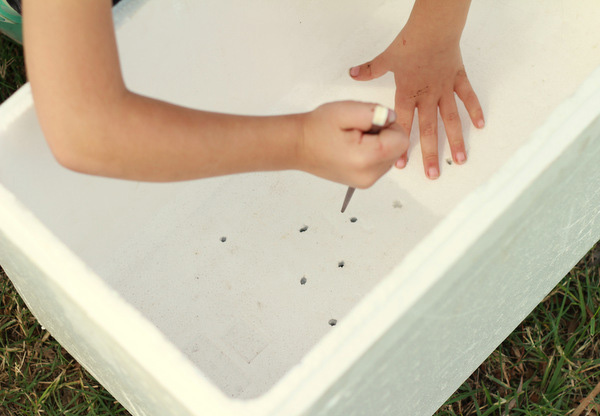
Unfortunately I had only one big styrofoam box and two little boxes. So I started with the big box and poked some drainage holes in the bottom. It would have been nice if I could collect this "worm wee" I read so much about, but I only had one box. The kids were also quite excited about the whole "pet worm" thing.

Image from Family Weekend Project: Practical Kids Make a worm farm
I did lots of reading and they said to put lots of "carbon" into the box. So I shredded lots of corrugated cardboard and paper and lined the bottom with a few pieces of newspaper so the worms didn't go out the holes as easily. Then I bought a box of worms from Bunnings and away they went.  However, we made more fruit peel than they could eat, so I decided to top up with another box of worms and see how that goes. I've been watching it carefully to make sure it's not too dry, and also to make sure food isn't going anaerobic in there. There are a few other bugs in there breaking down the food too, and I every morning we open the lid to see if we can see any worms eating the peelings and other scraps that we left there.  One website said that I should bury the food not leave it on top to help control the smell and I might do that for the second worm farm that I wanted to put in the house in square styrofoam boxes.

Then I decided I wanted to keep chickens. I'd been thinking about chickens for a while now, and I didn't have anywhere to put them, except in this area of the backyard that had lots of trees growing out of control in it. I've since cut down those trees, and there is a good space there for putting a coop, but we have the water tank collection thing there. However, I think we can cover it so the chooks don't poop on it, but I've finally gone ahead and bought a coop to put there from My Chicken Coop.


Thinking of starting with 2 Isa Brown hens, and I hope they're friendly so the kids can pick them up and have them treated like real pets. Also, looking forward to feeding them our scraps! I have resigned myself to being the person who cleans and looks after them (adding more time to my chores), but I figured I can at least use their poo on the garden.

Which brings me to the last thing, I finally bought a compost bin. After umming and ahhing about what to get, I bought an Aerobin 400, which seems to be a nice lazy composting bin that would work well for me. I would like to put the excess chicken poo in there and bedding (thinking of using hemp bedding rather than straw). I was doing a lot of reading about successful compost bins and it seems that having the right combination of nitrogen and carbon contents is the key. If you put too much food stuff in there it goes foul and stinky. And it has to be moist and warm too, much like the worm farm. I won't set it up until the chicken coop goes in, because I need some nice solid ground to put it on (like pavers or bricks) and I would like it near the chicken coop. I like how this person has set it up on a raised area.


But the vegies are doing well - the bok choy is growing wild on the tanbark because I threw the old seed pods there after I'd done a big seed harvest and they started growing so I thought, free food! So I've been looking after them, fertilizing and watering them, and even putting out slug and snail bait, and they have been growing nicely and should be right to have some leaves harvested in the next week or two.

I've also tried something my mother was telling me about. Her sister, my aunt, is the ultimate in recycling, and keeps chickens and grows her own vegetables. She collects large tins from her neighbours, punches holes in the bottom for drainage, puts compostable stuff in the bottom 5-10cm of the tin, chucks in some chicken poo and then potting mix on top and then plants vegetables in them and plonks them on the soil. She has containers growing vegies EVERYWHERE, and they're very successful!  My mother is a very keen gardener with a huge vegetable garden and takes great pride in her vegies but even she was impressed with her sister's work. My aunt gives eggs and vegies to her neighbours and in return they bring her their kitchen scraps and old tins and she feeds the chooks and makes more pots. So I decided to try that with my sister's empty baby milk powder tins, and have got some zucchini growing in one of them. It will be a bit of an experiment for me!

So currently I have dwarf beans, bok choy, carrots, spring onions, and cucumbers growing. I have just sown some thai basil, lettuce and zucchini and there are some wild spinach that have obviously grown from my failed earlier attempt at spinach (which bolted to seed because it was just too warm here). My poor chili plants have been resuscitated from the brink of death, and my Kaffir lime is growing all over the place (but never flowers or fruits). I have one basil plant that survived the slugs but I really should plant more if I want to get anything useful out of it!

I'm quite enamoured with my garden at the moment, having never thought I would be much of a green thumb, but I find it fun and the kids love to go outside and help water the plants and pick vegies. I bet they'll be even more excited to get eggs every morning!

Wednesday, 22 September 2010

Composting and why I haven't done it yet

For all my enthusiasm for ecosustainability and reduction of rubbish, my major failing continues to be composting.  Composting always seems like such hard work with all that turning and digging and I honestly just can't bring myself to be digging around in smelly waste.  Hubby was against it too because he says it attracts rodents and roaches.

Looking at one of the many types of compost bins on the market, I thought that the Earthmaker looked like a good choice.  It looks like I don't have to spin the damn thing and then dig compost out, basically I just add stuff to the top and then shake it through after a while and it comes out the bottom!  And if I get do it right and get the kids used to it then maybe I can teach them how to use the composter too.


So you add stuff in the top, then shake it a bit and it goes to the middle and then stir it some more and it goes to the bottom.  One thing I'm not sure about is how worms and other stuff gets in there.

Saturday, 25 July 2009

How I wish I could be more Green

In this age of eco friendly, carbon neutral, recycle and reuse, there are so many things I wish I could be doing. Unfortunately though, when you're married your partner has to be in on them too!

Electricity
I would love to install solar panels. The cost of it doesn't really worry me, but my husband refuses to buy them because they're not value for money. Sometimes I think, shouldn't we all be doing our bit for the environment? Despite the cost? Before June 2009, you could get $8000 back in rebates for installing a solar energy system under the SHCP (Solar home and communities plan). But the government dumped that and is in the process of replacing it with solar credits. Which is good because that is not means tested (the original one was). So I would love to get a 1.5kW system on my roof - but that would cost me about $16-17K. That's not including rebates. Or any money I would get from putting energy back into the grid.

At the moment this is a very energy inefficient household. We use about 21-27kWh per day, and the average house uses 16kWh. There are a number of things which contribute to this!
  • Computers - our computers are on A LOT. I love my computer. I do run 2 LCD monitors off mine and my husband has his one as well.
  • Ducted air conditioning - though we did our best to buy what we thought to be the most energy efficient on the market (Advantage Air) it still uses a lot of energy. And we spend a lot of time warming/cooling the house because of the baby, so she doesn't get too hot or cold.
  • Halogens - this house is FULL of halogen lights. They're in the bathrooms, kitchen, hallways.
Composting
I don't know much about gardening and things. I should invest in a worm farm or a compost bin, but getting my husband to put food scraps into it may be a bit of an issue! This is one area I'll be looking into later when I have more time. These are the things I'm going to investigate at a later stage:


Recycling
Gee we generate lots of rubbish. I do try and recycle as much as I can, but I'm sure I could do more. I threw out a chocolate box yesterday because it didn't have the recycling symbol on it and my husband scolded me, saying "You want to be environmentally friendly? You don't even recycle!" I don't want to try to recycle things which aren't recyclable, that makes more work for the people at the recycling place!

Water recycling
It would be nice to get laundry and other grey water back into the garden. But I hardly water my garden and the raintank outside takes care of that anyway so I don't think that it's really needed at this stage. Perhaps when I get a bigger house. We already have water efficient things all through the house - shower heads, toilets, front loading washing machine.

Growing your own vegetables
Now this would probably make a tiny difference in my carbon footprint! Think of all the transport of produce I would save... and not to mention home grown stuff! At the moment I only have herb type things such as coriander, chilli, lemongrass, kaffir lime, chives. But other things I would love to plant would include basil, lemons, tomatoes and sugar snap peas!